
-
 About Us
-
 Vehicle & Transportation Wiring Solutions
-
 Industrial Connectivity
-
 Custom Engineering & PCBA
-
 Customization
-
 Quality Control
-
 Resources
-
 Newsroom
-
 Contact Us
About Us
Vehicle & Transportation Wiring Solutions
Industrial Connectivity
Custom Engineering & PCBA
Customization
Quality Control
Resources
Newsroom
Contact Us

Home / Newsroom / Blogs / How to Avoid Signal Interference in PCBA-to-Harness Assemblies: A Comprehensive Guide
Newsroom
In the era of smart vehicles and industrial automation, the "dialogue" between the PCBA (Printed Circuit Board Assembly) and the Wire Harness has never been more critical. However, as devices become more compact and frequencies increase, Signal Interference (EMI/EMC) has become a silent killer of system reliability.
A stray electromagnetic pulse can cause sensor errors, data loss, or even total system failure. At Kinkong, we believe that solving interference isn’t just a PCB task—it’s a holistic engineering challenge.
Here is how we ensure seamless, interference-free communication between your PCBA and wiring system.
The most vulnerable point for signal interference is the connection interface. When a signal leaves the shielded environment of a multi-layer PCB and enters a wire harness, it acts like an antenna—either radiating noise or picking it up.
Our Approach:
Impedance Matching: We ensure the connectors and wire types are perfectly matched to the PCB’s trace impedance (e.g., 90 ohms for USB or 100 ohms for Ethernet) to prevent signal reflection.
Precision Soldering & Crimping: Poor connections create resistance "hotspots" that fluctuate with vibration. We utilize automated crimping and AOI (Automated Optical Inspection) to guarantee physical integrity.
For high-frequency signals or low-voltage sensors (like those in EV battery management systems), standard PVC wires aren't enough.
Braided Shielding: We utilize tinned copper or aluminum braiding for the harness sections most exposed to external EMI.
360° Grounding: A shield is only as good as its ground. We ensure the harness shield is bonded 360 degrees to the connector shell or a dedicated ground plane on the PCBA to drain unwanted currents.
One of the simplest yet most effective ways to cancel out interference is through precision twisting. By twisting the signal and return wires, the magnetic fields cancel each other out (Differential Mode).
Tight Tolerance: At Kinkong, we calculate the optimal "lay length" (twists per inch) based on your signal frequency to ensure maximum noise rejection without adding unnecessary bulk to the harness.
Sometimes, the noise is generated by the PCBA itself (from switching power supplies or motors).
Ferrite Beads: We can integrate ferrite cores directly into the wire harness assembly to act as a low-pass filter, "choking" high-frequency noise before it escapes the housing.
Alternative Diode & Capacitor Sourcing: As we recently helped a client with STPS2L60A alternatives, choosing components with low ESR (Equivalent Series Resistance) on the PCBA can drastically reduce the "ripple" that enters the wire harness.
Environmental factors like moisture and dust can create "leakage paths" on a PCBA, leading to intermittent signal noise.
Kinkong’s Specialized Solution: Our custom over-molding process seals the PCBA-to-connector junction. This doesn't just provide IP67 waterproofing; it acts as a vibration dampener, ensuring that the delicate solder joints between the PCB and the wire leads remain stable under extreme mechanical stress.
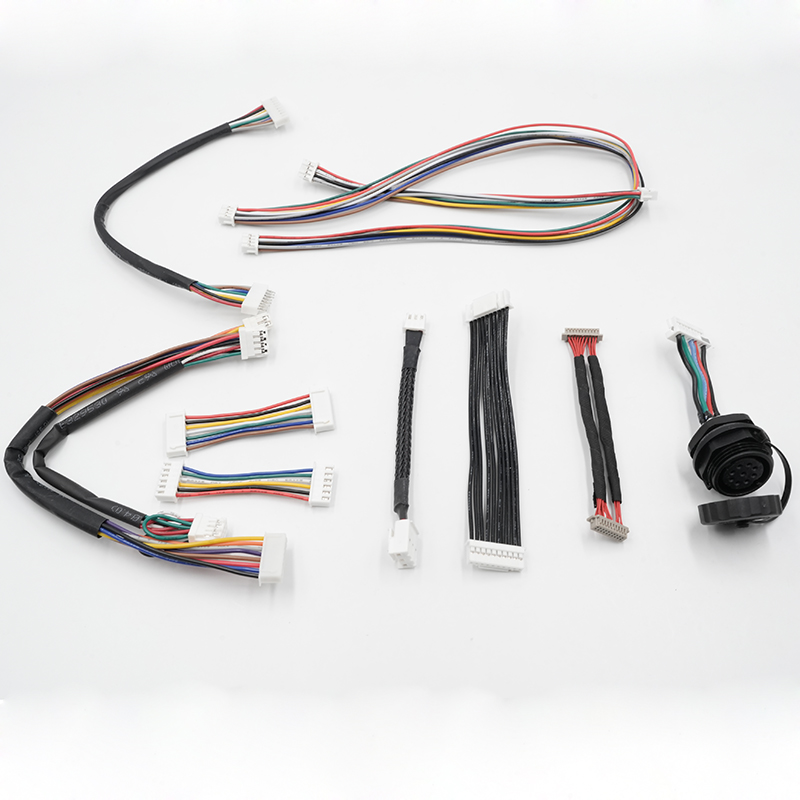
Avoiding signal interference requires a partner who understands both the logic of the board and the physics of the cable. By managing the PCBA and Wire Harness as a single integrated system, you reduce debugging time and prevent costly field failures.
Ready to de-risk your next project?Whether you are designing a high-speed telematics unit or a heavy-duty agricultural controller, the Kinkong engineering team is here to help you optimize your PCBA-to-Harness assembly.
None